
World War 3 and Technology: How AI, Cyber Warfare, Drones, and Digital Systems Could Shape the Future of Conflict
In This Article
- The New Meaning of War in the Digital Era
- AI as the Brain of Future Warfare
- Cyber Warfare: The Silent Battlefield
- Drones and Autonomous Systems on the Front Line
- Satellites and Space Infrastructure as Strategic Assets
- Semiconductors and the Global Supply Chain Problem
- Cloud Infrastructure and Data Centers
- Propaganda, Deepfakes, and Information Warfare
- The Role of Defense Technology and Innovation
- Why Technology Also Creates Restraint
- The Future of Warfare Will Be Hybrid
- Final Thoughts
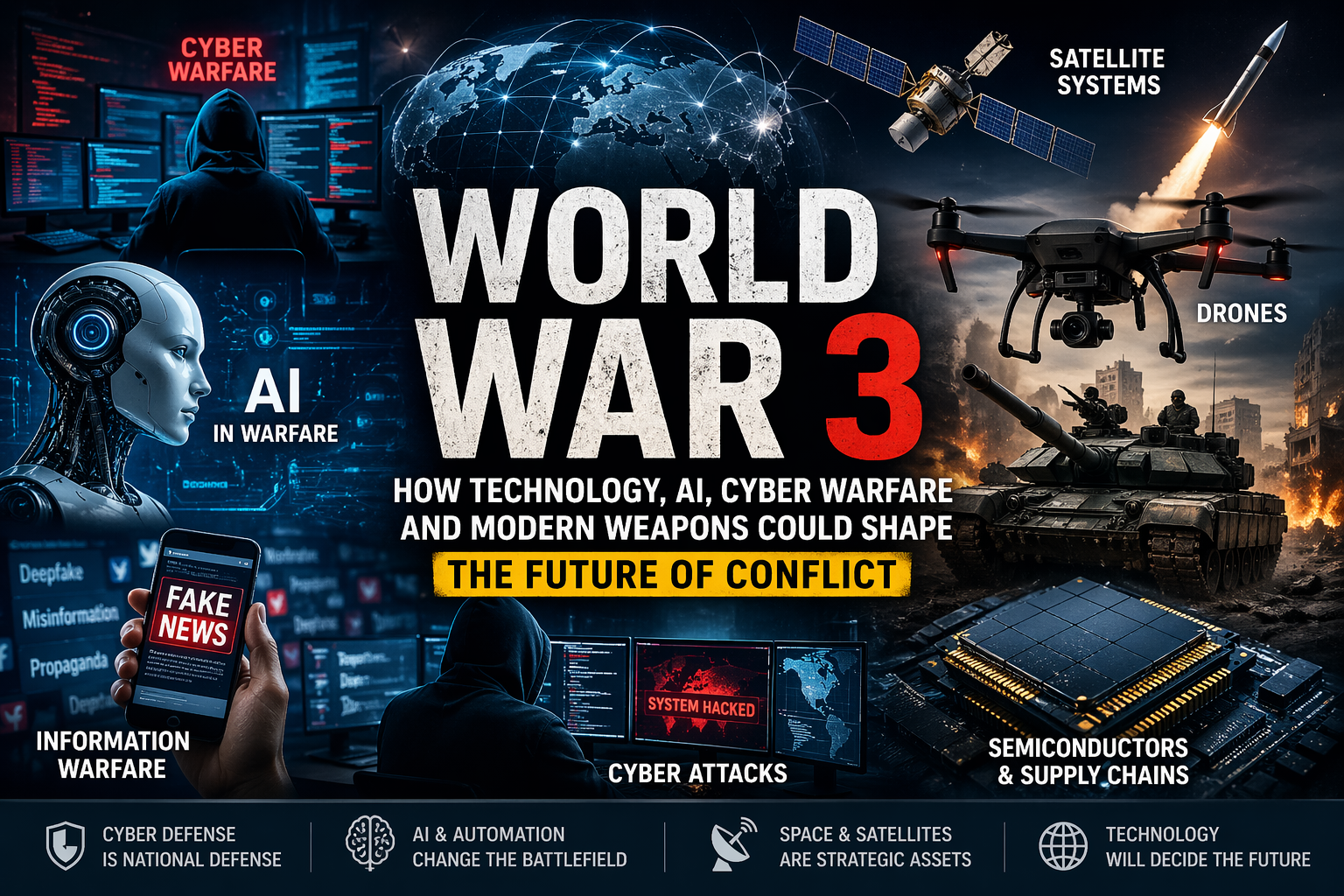
The phrase World War 3 is one of the most searched and most feared terms in modern history. It reflects not just public anxiety, but also a deeper concern about how future global conflict could look in a world driven by technology. Unlike the wars of the past, a future world war would not be fought only with tanks, bombs, and soldiers on the ground. It would also be fought through code, satellites, autonomous systems, cyberattacks, artificial intelligence, drones, cloud infrastructure, semiconductor supply chains, and information control.
That is why any discussion about World War 3 today is also a discussion about technology. The battlefield has changed. Power is no longer defined only by armies and weapons. It is also defined by data, networks, computing systems, intelligence capabilities, digital resilience, and the ability to disrupt an enemy without ever crossing a border physically.
This article explores how technology could shape a future global war, why cyber warfare may be just as important as physical warfare, and how AI, robotics, communications, and supply chains could influence the balance of power. The goal is not to predict war, but to understand how modern technology has changed the meaning of conflict itself.
The New Meaning of War in the Digital Era
In the past, war was mostly visible. You could see soldiers, vehicles, borders, and battle lines. In the modern era, some of the most important actions in conflict may happen invisibly. A cyberattack can disrupt hospitals, airports, banks, power grids, or government systems without a single missile being fired. A satellite failure can damage communication across an entire region. A supply chain disruption can slow the production of chips, weapons, phones, vehicles, and critical infrastructure.
This means a future world war may begin long before the first public declaration. It may start in networks, with misinformation, cyber espionage, sabotage, and digital interference. Technology is no longer just a support system for war. It has become one of the main tools of war.
The countries that can protect their systems, control information, and maintain digital superiority may hold a major advantage. Those that cannot may find themselves vulnerable even if they have strong traditional military power.
AI as the Brain of Future Warfare
Artificial intelligence is likely to play a major role in any future large-scale conflict. AI can process large amounts of information much faster than humans. It can identify patterns, detect threats, support decision-making, manage logistics, and even help control autonomous defense systems.
In a World War 3 scenario, AI could be used for many purposes. It could help analyze satellite imagery to detect troop movement. It could support battlefield decisions by predicting likely enemy actions. It could improve missile defense systems by spotting incoming threats faster than human operators. It could also help automate cyber defense by identifying attacks in real time.
At the same time, AI creates serious risks. If military systems become too dependent on machine decision-making, then speed may increase while human control decreases. That creates the danger of escalation based on faulty data, software errors, or misinterpretation. AI can be powerful, but it is not perfect. If used in the wrong way, it could make conflict faster, more unpredictable, and harder to control.
Another concern is the use of AI in misinformation. In a future global war, AI-generated content could be used to spread fake videos, fake statements, fake images, and fake news at massive scale. That could confuse populations, weaken trust, and create panic before anyone realizes what is happening.
Cyber Warfare: The Silent Battlefield
If World War 3 ever happens, cyber warfare may be one of the earliest and most important fronts. Cyber warfare refers to attacks on digital systems, networks, and infrastructure. It includes hacking, sabotage, data theft, malware, ransomware, denial-of-service attacks, and covert interference.
The reason cyber warfare matters so much is simple: modern society depends on digital systems. Electricity grids, water systems, financial institutions, transport networks, hospitals, communication platforms, military logistics, and government services all depend on technology. If those systems are disrupted, the effects can spread quickly.
In a major conflict, cyberattacks could be used to disable communication between military units, shut down financial markets, block supply chains, or interrupt civilian services. Unlike conventional attacks, cyberattacks can be hard to trace, hard to defend against, and difficult to attribute with full certainty. That makes them especially dangerous.
Cyber warfare also lowers the threshold for conflict. A country may launch cyber operations long before open military action begins. That creates a grey zone where war exists, but public recognition is delayed. In this sense, the next world war may not start with a dramatic military event. It may start quietly with a network breach or a digital intrusion.
Drones and Autonomous Systems on the Front Line
Drones have already changed modern conflict, and their importance would likely grow even more in a large-scale war. They are cheaper than many traditional weapons, easier to deploy, and useful for both surveillance and attack. In future conflict, drones could be used for reconnaissance, precision strikes, border monitoring, and coordinated swarm attacks.
The next step is autonomy. Instead of human operators controlling every move, drones and robotic systems may increasingly make decisions on their own or with minimal human oversight. This could create faster reaction times and reduce risks to soldiers, but it also raises serious ethical and strategic concerns.
Autonomous systems may make mistakes, misidentify targets, or behave unpredictably in complex environments. If multiple autonomous systems interact with each other during conflict, the result could be escalation that no human intended. That is why many experts argue that autonomous weapons should remain under meaningful human control.
Still, one thing is clear: drones and robotics will be central to future military strategy. They are becoming smaller, smarter, and more connected. In a world war scenario, they could be used to overwhelm defenses, gather intelligence, and execute precision operations at scale.
Satellites and Space Infrastructure as Strategic Assets
A future world war would not be limited to land, sea, air, and cyber. Space infrastructure could also become a major strategic domain. Satellites support navigation, communication, weather forecasting, surveillance, and military coordination. If a country loses access to its satellite network, its operations become much harder.
That makes satellites highly valuable targets. Disrupting satellite communication, jamming signals, or interfering with orbital systems could affect both military and civilian systems. GPS failure alone could impact aviation, shipping, emergency response, logistics, and defense systems.
As space becomes more crowded and more commercial, the line between civilian and military infrastructure may also blur. Private satellite companies, cloud providers, launch operators, and telecom firms may all become part of the strategic environment whether they want to or not.
In a future global conflict, space could become one of the most important invisible battlegrounds.
Semiconductors and the Global Supply Chain Problem
One of the most overlooked aspects of future conflict is the semiconductor supply chain. Chips power nearly everything: smartphones, computers, vehicles, weapons systems, satellites, cloud servers, and AI models. Without semiconductors, modern technology cannot function.
If a World War 3 scenario disrupted chip manufacturing, the consequences would spread across the global economy. Military systems could be slowed down. Consumer electronics production could drop. Cars could become harder to build. Data centers could face shortages. Entire industries could struggle to operate.
This is why semiconductor manufacturing is now a geopolitical issue. Countries want control, resilience, and diversification in chip supply. A conflict affecting major semiconductor production hubs could create global disruption far beyond the battlefield.
The same is true for rare earth materials, energy systems, shipping routes, and critical manufacturing regions. Technology does not exist in isolation. It depends on physical supply chains that are vulnerable to war, sanctions, blockades, and instability.
Cloud Infrastructure and Data Centers
Another critical part of future warfare is cloud infrastructure. Cloud platforms store and process enormous amounts of data for businesses, governments, and defense systems. They support communication, AI models, logistics, intelligence analysis, and public services.
If cloud infrastructure is disrupted, the impact could be enormous. A cyberattack on cloud providers or data centers could affect countless connected services at once. That means future conflict may not only target military assets. It may also target digital backbone systems that support entire societies.
This creates a new kind of strategic vulnerability. Countries and companies increasingly rely on a small number of large digital providers. If those systems are attacked, the disruption can spread globally.
That is why digital resilience is now a national security issue. Future military planning will likely include cloud continuity, distributed systems, backup architecture, and cyber resilience as core components.
Propaganda, Deepfakes, and Information Warfare
Technology has also changed the information battlefield. In a future world war, controlling the narrative may be as important as controlling territory. Social media, AI-generated content, deepfakes, and automated influence campaigns could be used to confuse citizens, shape public opinion, and weaken trust.
A deepfake video of a leader making a false statement could go viral in minutes. Fake emergency alerts could create panic. AI-generated propaganda could flood platforms with contradictory claims. Information warfare may become so intense that it becomes difficult for ordinary people to know what is true.
This is dangerous because trust is one of the first things to break during conflict. If people do not trust the news, institutions, or official communication, then even limited incidents can produce widespread fear. Technology makes it easier than ever to manipulate perception at scale.
That is why media literacy, verification tools, and digital authentication may become essential parts of national defense.
The Role of Defense Technology and Innovation
A future World War 3 would likely accelerate innovation in defense technology. Countries would invest heavily in better sensors, autonomous platforms, cyber defense, secure communications, electronic warfare, and battlefield analytics. The pace of innovation during conflict could be extremely fast, because the pressure to adapt would be immense.
Historically, war has often accelerated technology. The difference now is that the technology cycle is already moving quickly before any major global conflict begins. That means war could further intensify a trend that is already reshaping society.
Defense technology may also become increasingly connected to private industry. Many of the most advanced tools in AI, cloud computing, robotics, cybersecurity, and satellite systems are developed by commercial companies, not just governments. That means future conflict may depend heavily on public-private collaboration.
Why Technology Also Creates Restraint
While technology can make war more powerful, it can also make leaders more cautious. Nuclear weapons already created a powerful deterrent effect in previous decades. In the modern era, the complexity of digital systems may create new forms of restraint. The risk of global economic collapse, infrastructure damage, cyber escalation, or accidental disruption may discourage direct conflict between major powers.
This is one reason why some experts believe a full-scale world war is less likely than smaller, more fragmented conflicts, cyber campaigns, proxy wars, and economic pressure. The more interconnected the world becomes, the more dangerous a major war becomes for everyone involved.
Technology can therefore work in two directions. It can increase capability, but it can also increase the cost of conflict.
The Future of Warfare Will Be Hybrid
The most likely future is not a war that is purely digital or purely physical. It will be hybrid. That means cyberattacks, AI systems, drones, satellites, economic pressure, disinformation, and traditional military power could all be used together.
In such a world, no single technology will decide the outcome. Success will depend on integration. The side that can combine intelligence, speed, resilience, logistics, and communication may gain the advantage.
This is why the future of conflict is not just a military issue. It is a technology issue, a supply chain issue, a data issue, and a resilience issue.
Final Thoughts
When people search for World War 3, they are often looking for fear, prediction, or breaking news. But the deeper story is technological. A future global conflict would not look like the wars of the past. It would be faster, more connected, more automated, and more dependent on digital systems.
AI would help shape decisions. Cyber warfare would attack networks and infrastructure. Drones and autonomous systems would change the front line. Satellites would become strategic assets. Semiconductor supply chains would become pressure points. Information warfare would target truth itself.
That does not mean war is inevitable. But it does mean the relationship between technology and conflict is now impossible to ignore. The countries that understand this will be better prepared for the future. The ones that do not may find themselves vulnerable in ways that are hard to see until it is too late.
In the end, World War 3 is not just a military concept anymore. It is also a technological one. And that makes the question of how we build, protect, and govern technology one of the most important questions of our time.
About The Author


Hamza Malik
Keep Reading
World War 3 and Technology: How AI, Cyber Warfare, Drones, and Digital Systems Could Shape the Future of Conflict
The phrase World War 3 is one of the most searched and most feared terms in…