What Country Has the Most Cyber Warfare? The Real Answer in 2026
In This Article
- What “cyber warfare” actually means
- The strongest answer: China is usually the most active in espionage
- Why Russia still matters so much
- Iran and North Korea are smaller than China and Russia, but still dangerous
- Why the answer changes depending on the metric
- What the data says about the real threat landscape
- So which country has the most cyber warfare?
- What this means for businesses and governments
- Final answer
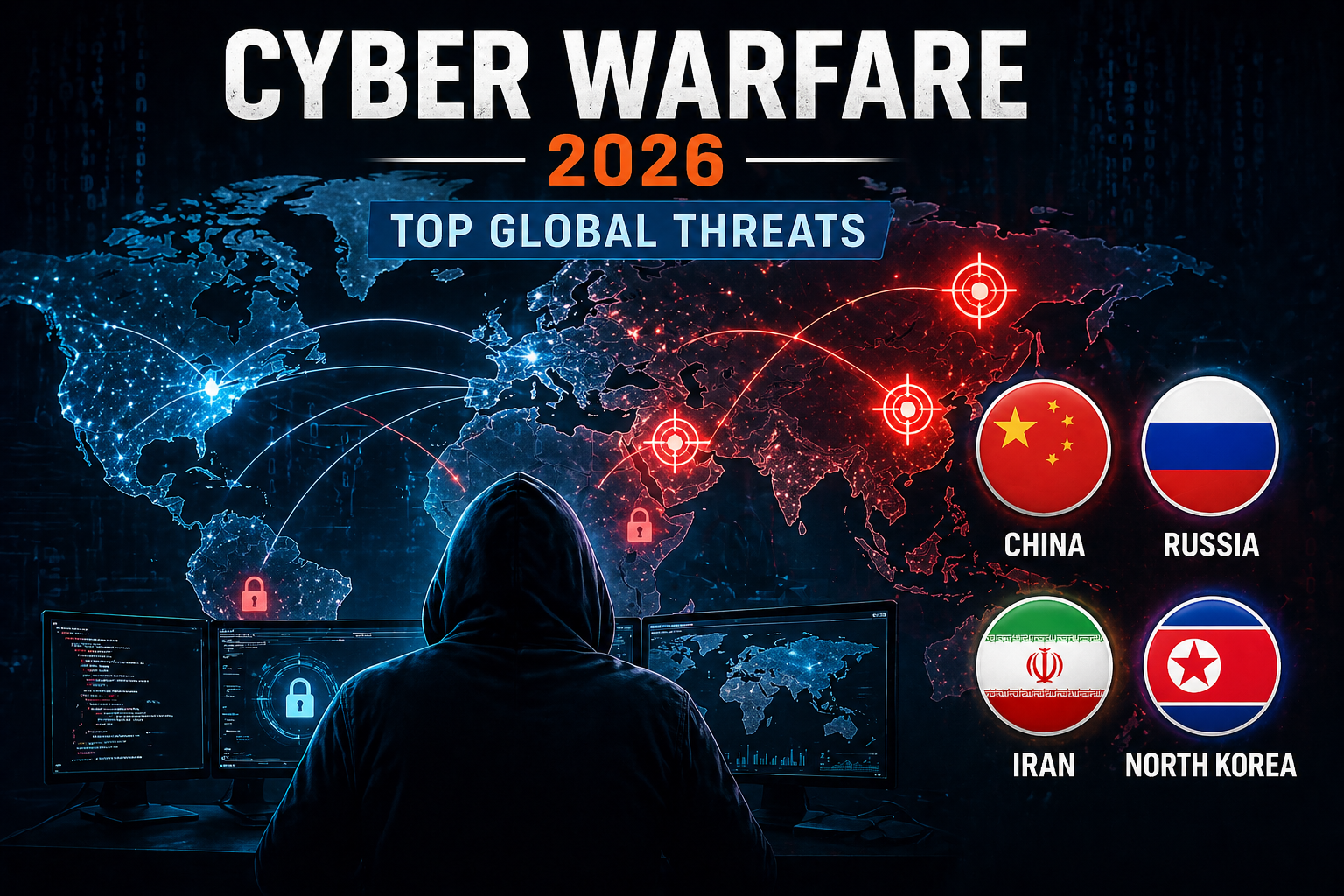
There is no single country that can honestly be called the absolute “winner” of cyber warfare across every metric. The answer changes depending on what you mean by cyber warfare. If you mean state-sponsored cyber espionage, China is the country most often described by major intelligence and threat reports as the most active and persistent actor. If you mean disruptive or destructive operations, Russia is one of the most prominent cyber adversaries. And if you mean the broader state-backed cyber landscape, the recurring list is the same: China, Russia, Iran, and North Korea. At the same time, Microsoft’s 2025 government summary notes that most incidents it investigated were still cybercriminal, not nation-state, activity, which is an important reminder that “cyber warfare” is only one part of the cyber threat picture.
That is the most accurate answer in 2026. The question sounds simple, but the reality is not. Different reports measure different things: espionage, disruption, ransomware, influence operations, critical infrastructure targeting, or defense-industrial targeting. When you compare those categories carefully, the picture becomes much clearer: China leads in espionage volume, Russia remains the most durable disruptive cyber power, and Iran and North Korea are major, persistent secondary actors.
What “cyber warfare” actually means
People often use “cyber warfare” as a catch-all phrase, but intelligence and threat-intelligence reports usually split it into separate buckets. One bucket is cyber espionage, where an actor steals information, access, or intelligence. Another is disruption or destructive attack, where the goal is to interrupt systems, destroy data, or undermine operations. A third is influence operations, where cyber tools are used to shape opinion, spread confusion, or support broader geopolitical goals. Google’s 2025 forecast explicitly says the major state-backed actors pursue their goals through cyber espionage, disruption, and influence operations, which shows how broad the term really is.
That distinction matters because the country that is “best” at espionage is not always the country most associated with destructive attacks. It also matters because many of the biggest cyber incidents in the real world are not even state-sponsored. Microsoft’s 2025 government executive summary says the vast majority of attacks are conducted by cybercriminals, not nation-state actors, and its incident-response data showed extortion and destructive ransomware were more common motivations than espionage. So when people ask which country has “the most cyber warfare,” they are often mixing cybercrime, espionage, sabotage, and wartime-style cyber operations into one question.
The strongest answer: China is usually the most active in espionage
If you force the question into one country and one category, the strongest answer is usually China. The U.S. intelligence community’s 2023 Annual Threat Assessment said China “probably currently represents the broadest, most active, and persistent cyber espionage threat” to U.S. government and private-sector networks. The 2026 Annual Threat Assessment goes even further, calling China the “most active and persistent cyber threat” to U.S. government, private-sector, and critical infrastructure networks. That is a major statement, and it is one of the clearest official indicators available.
Google’s 2026 cybersecurity forecast supports the same basic conclusion. It says the volume of China-nexus cyber operations is expected to continue surpassing that of other nations, and it describes China-nexus actors as prioritizing stealthy operations, edge-device exploitation, and zero-day use. Google’s defense-industrial-base analysis is even more pointed: among the state-sponsored cyber espionage intrusions it analyzed over the last two years, China-nexus activity was the most active threat by volume, and China-nexus actors accounted for more defense and aerospace targeting than any other state-sponsored actors over that period.
That does not mean China is the only serious cyber actor. It means that if the metric is scale, breadth, persistence, and espionage volume, China is the country most consistently named at the top by major intelligence and threat-intelligence sources. China’s cyber operations are also tied to intelligence collection, technology acquisition, and strategic access, which is why the threat is often described as persistent rather than episodic.
Why Russia still matters so much
If China is the strongest answer for espionage volume, Russia is the strongest answer for disruptive and destructive cyber operations. The 2026 U.S. Annual Threat Assessment says Russia poses a “persistent, advanced cyber attack and foreign intelligence threat.” That wording is important because it reflects a different posture from China’s broad espionage model. Russia is often treated as a cyber actor that can move from intelligence collection into coercive disruption, especially when geopolitical pressure rises.
Google’s 2026 forecast says Russian cyber operations are expected to undergo a strategic shift, prioritizing long-term global strategic goals and advanced cyber capability development rather than just tactical support for the war in Ukraine. That suggests Russia’s cyber posture is not static. It is evolving toward more persistent strategic competition, which matters because cyber warfare is often less about one dramatic event and more about sustained capability building over time.
Russia is also part of a broader state-adversary ecosystem that includes China, Iran, and North Korea. CSIS has described the growing cooperation among these countries as an important security trend, and its work on the “CRINK” alignment shows that their coordination has implications beyond one-off attacks. In other words, Russia’s cyber power is amplified by the broader geopolitical environment, even when the operations themselves are not directly coordinated in a formal alliance structure.
Iran and North Korea are smaller than China and Russia, but still dangerous
Iran is not the largest cyber power in the world, but it is still a serious actor. The 2026 U.S. Annual Threat Assessment says Iran poses a threat to U.S. networks and critical infrastructure through cyber espionage and cyber attacks. It also says Iran’s cyber operators have previously used cyber attacks against poorly defended targets and weaker opponents, and that Iran remains intent on targeting the U.S. and its allies. That means Iran’s cyber activity is often opportunistic, geopolitical, and coercive rather than simply opportunistic crime.
North Korea is different again. The 2026 Annual Threat Assessment says North Korea’s cyber program is sophisticated and agile, combining espionage, cybercrime, and cyber attacks. It also notes that North Korea uses IT workers with falsified credentials and that crypto heists continue to generate at least $1 billion annually to support the regime’s weapons programs. So while North Korea may not have the same breadth as China or the same destructive reputation as Russia, it is still a major state cyber actor with a distinct financial and sanctions-evasion angle.
Google’s 2025 forecast summarized the group this way: the “Big Four” — China, Iran, North Korea, and Russia — will continue to pursue geopolitical goals through cyber espionage, disruption, and influence operations. That is one of the cleanest ways to think about the current landscape. If you are asking which country has “the most cyber warfare,” the honest answer is that the world is dominated by a small set of state-backed cyber powers, not a long list of equally powerful players.
Why the answer changes depending on the metric
This is the part most people miss. “Most cyber warfare” is not a single measurable thing. If you measure by espionage volume, China tends to lead. If you measure by disruptive or destructive capability, Russia becomes much more prominent. If you measure by financially motivated cyber incidents, then nation-states are not even the majority; cybercriminals are. Microsoft’s 2025 executive summary is explicit that most incidents it investigated were criminal rather than state-sponsored, with extortion and destructive ransomware appearing far more often than espionage in its incident-response work.
That means the answer changes depending on who is counting and what they are counting. The U.S. intelligence community looks at national security threats to U.S. government, private-sector, and critical infrastructure networks. Google’s threat-intelligence teams may look at defense industrial base targeting or broader cloud and enterprise risk. Microsoft may look at incident response across organizations, with a strong focus on what actually happened in the field. Those different lenses produce slightly different rankings, even when they point to the same core actors.
So if someone says “Country X has the most cyber warfare,” your first question should be: most by what measure? Most by stolen data? Most by number of campaigns? Most by destructive incidents? Most by defense-industry targeting? Most by geopolitical intent? Once you ask that question, the answer becomes much more precise.
What the data says about the real threat landscape
The most important practical conclusion from the current reporting is that the world’s cyber threat landscape is dominated by two layers at once. The first layer is state-sponsored cyber activity, where China, Russia, Iran, and North Korea continue to pursue geopolitical objectives. The second layer is cybercrime, which remains the most common form of attack overall. Microsoft’s government summary and Google’s threat reporting both reinforce that organizations are dealing with both at the same time.
That combination makes defense hard. State actors often focus on espionage, long-term access, and strategic positioning. Cybercriminals often focus on extortion, theft, and disruption for profit. The result is that a company may face a ransomware attack one month and a state-linked intrusion the next. Microsoft’s data also shows that government, IT, and research organizations are among the most frequently impacted sectors, which makes sense because those sectors hold sensitive data and play central roles in national infrastructure and innovation.
Google’s 2026 forecast adds another important detail: Chinese state-sponsored actors have used AI to automate espionage code-writing, which suggests the barriers to entry for sophisticated cyber operations are dropping. That matters because it means the scale of cyber activity can grow without every attack requiring elite manual effort. In simple terms, cyber warfare is becoming easier to industrialize.
So which country has the most cyber warfare?
Here is the most honest answer I can give based on current intelligence and threat-intelligence reporting: China is the closest thing to the leader in state-sponsored cyber warfare if you define cyber warfare as broad, persistent cyber espionage and strategic access. The U.S. intelligence community says China is the most active and persistent cyber threat, and Google says China-nexus operations continue to surpass others in volume in several important contexts.
But if you define cyber warfare more narrowly as destructive or coercive cyber operations, then Russia becomes the stronger candidate because of its persistent advanced cyber attack posture and its long-running association with disruptive operations in high-stakes geopolitical conflicts. Iran and North Korea also remain major actors, especially in targeted attacks, cybercrime, and strategic coercion.
So the best one-line answer is this: China leads in cyber espionage scale, Russia leads in disruptive cyber warfare reputation, and the broader state-backed cyber battlefield is dominated by the Big Four: China, Russia, Iran, and North Korea. That is the most defensible answer if you want accuracy rather than a catchy but misleading headline.
What this means for businesses and governments
For businesses, the lesson is not to obsess over one country alone. The better question is whether your organization is prepared for the kind of threat each actor brings. China-nexus actors often emphasize stealth, edge-device exploitation, and long-term access. Russia-linked threats are associated with persistent attack capability and potential disruption. Iran and North Korea add their own mixes of attacks, espionage, financial theft, and opportunistic exploitation. That variety is exactly why government, IT, research, and critical-infrastructure organizations are such common targets.
For governments, the implication is broader still. Cyber warfare is not happening in a vacuum. It is intertwined with diplomacy, sanctions, military competition, AI adoption, space systems, and supply-chain risk. The U.S. intelligence community says these cyber actors continue to pour resources into operations to compromise systems and core global IT resources, while Google notes that nation-states are increasing both the breadth and depth of their attacks. That means cyber defense is no longer just an IT issue; it is a national-security and economic-security issue.
Final answer
If you came here asking, “What country has the most cyber warfare?” the most accurate answer is: there is no single country that wins every version of that question. If you mean overall state-sponsored cyber espionage, China is the strongest answer. If you mean disruptive and destructive cyber warfare, Russia is the other major contender. If you mean the full global picture, the main state actors are the Big Four: China, Russia, Iran, and North Korea. And if you mean all cyber incidents in general, most are still cybercriminal rather than nation-state operations.
That is why the real lesson is not to look for a single villain and stop there. The cyber battlefield is already multi-layered, and the countries that matter most are the ones with persistent access, strategic intent, and the ability to adapt quickly. Right now, China sits at the top of the espionage conversation, Russia sits near the top of the destructive-attack conversation, and the rest of the world has to defend against both at once.
About The Author


Hamza Malik
Keep Reading
What Country Has the Most Cyber Warfare? The Real Answer in 2026
There is no single country that can honestly be called the absolute “winner” of cyber warfare…