
eSIM News 2026: The Tiny Chip That’s Quietly Changing How the World Connects
Here’s a question most people can’t answer:
When did you last physically hold a SIM card?
Don’t tap it. Don’t switch it. Just hold that little plastic card, pop it out of a tray, squint at
the tiny text, and try not to drop it on the floor.
If you’re using a recent iPhone, a modern Samsung flagship, or the latest Google Pixel, you
might not even remember the last time. Because that tiny physical card, once a staple of
mobile connectivity for decades, is disappearing fast.
The technology replacing it is called an eSIM.
And in 2026, this shift is no longer coming. It is happening at scale, and it is quietly
becoming the new way the world connects.
What is an eSIM? (And Why Should You Care)
Let’s keep this simple.
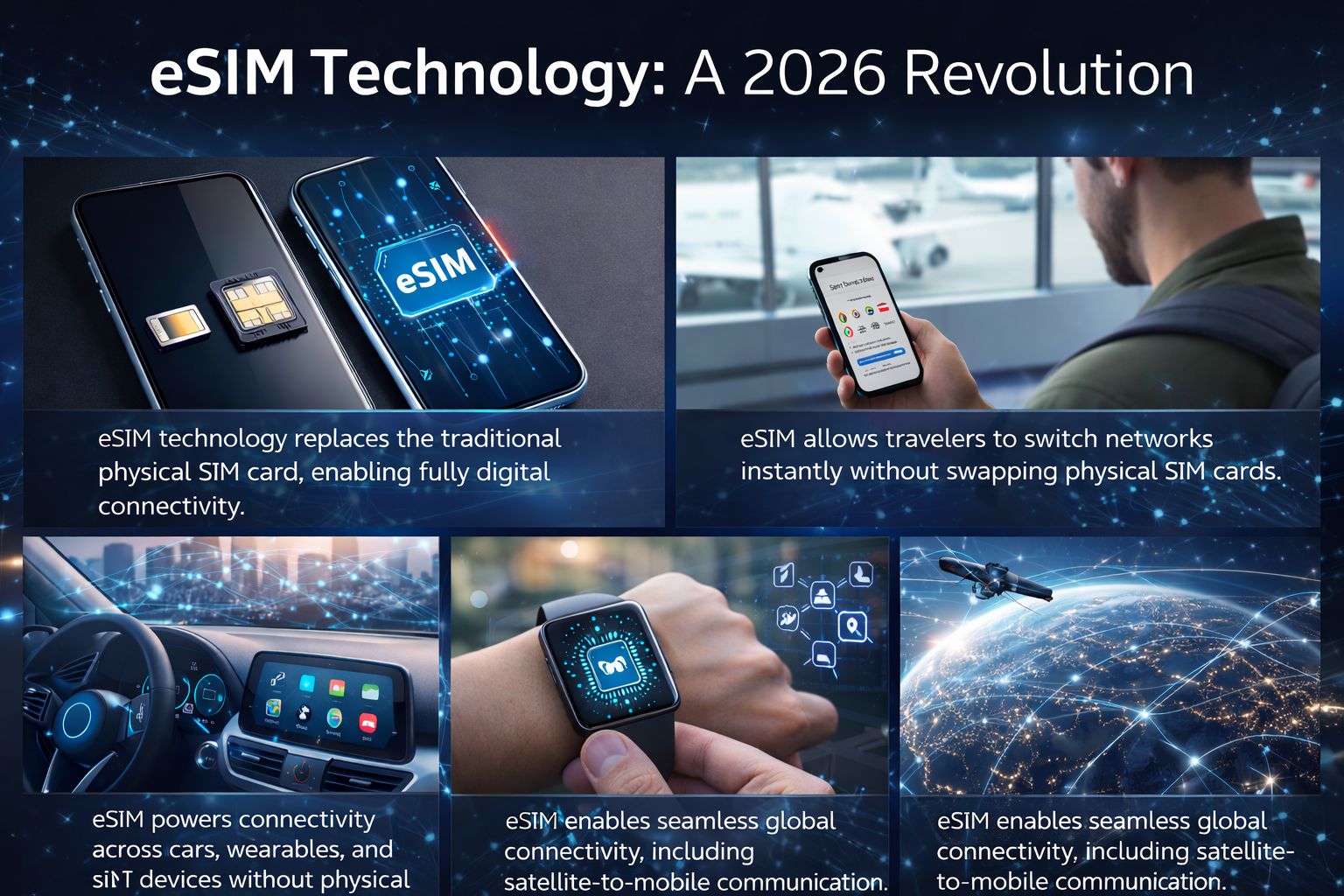
A traditional SIM card is a small physical chip you insert into your phone. It identifies your
device to the network and connects you to your carrier. But it comes with real friction: you
need a dedicated slot, a new card when switching carriers, and during international travel,
you either pay high roaming fees or juggle multiple cards like a telecom juggler.
An eSIM (embedded SIM) solves all of that.
It is built directly into the device’s circuit board, with no slot, no tray, and no tiny metal
card to lose. Instead of physically swapping cards, you download a carrier profile over the
internet. Thinking of changing your phone service? Create a new profile.
Heading to Japan for a week? You can set up a local data plan in a matter of seconds,
straight from your phone, and without needing to talk to anyone.
That’s the core idea. And in 2026, eSIM is moving from early adoption to mainstream
status in a big way.
It’s also worth noting that many devices still support a hybrid setup, one physical nano-SIM
combined with one or more eSIM profiles. The dual-SIM capability is still a significant
advantage, particularly for those traveling or living abroad.
It’s a different story elsewhere, where the shift to complete digital integration is still
unfolding.
It’s just so massive.
Just how big is it, really?
eSIM adoption has moved well beyond the initial phase.
Global eSIM connections are forecasted to hit 1.5 billion by 2026, a 30% increase from the
1.2 billion expected in 2025. The volume of eSIM shipments is also anticipated to grow,
reaching 0.65 billion units in 2026. This growth trajectory is projected to continue, with a
target of 2.12 billion units by 2031, reflecting a compound annual growth rate (CAGR) of
26.67%.
In 2025, eSIM shipments worldwide hit over 600 million, marking the most significant year
for widespread adoption to date.
Around 65% of new smartphones launched in 2024–2025 now support eSIM.
The worldwide travel eSIM market is expected to reach roughly $1.75 billion by 2026.
Retail spending in this sector is forecasted to increase five times over the period from 2023
to 2028.
The most revealing number?
eSIM smartphone connections skyrocketed, almost doubling in just twelve months.
They jumped from 310 million in 2023 to 598 million in 2024.
That’s not a slow rollout.
That’s acceleration.
Why 2026 Feels Different: The Tipping Point
eSIM has technically existed for nearly a decade, with the first compatible smartphones
appearing in 2017. So why does 2026 feel like a genuine turning point?
Three significant developments came together.
- First, Apple made the transition inevitable. In 2022, the company eliminated the physical
SIM tray from all iPhones sold in the United States. Then, this year, Apple took things a step
further. They released the iPhone Air, which is exclusively eSIM, and also introduced
eSIM-only versions of the iPhone 17 series in over eleven countries.
Apple’s decisions ripple through the telecommunications world, compelling carriers and the
broader industry to adapt. - Google joined the momentum
Google followed with the Pixel 10, launching it as an eSIM-only device. Two of the world’s
most influential smartphone platforms now ship flagships without a physical SIM slot. - China made a significant move. In October 2025, China Mobile, China Unicom, and China
Telecom began rolling out commercial eSIM trials and services nationwide. While activating
an eSIM often still requires face-to-face verification and identity checks, the rollout is
expanding, and this trend is expected to persist into 2026.
This has given Chinese manufacturers Huawei, Xiaomi, Oppo, and Vivo a compelling reason
to incorporate eSIM technology into their mid-range and budget devices, which are
particularly popular in developing markets across Asia and Africa.
Things are unfolding just as they should.
The Travel Story: Where Most People First Experience eSIM
For the majority of users, their first encounter with eSIM comes during travel.
According to GSMA, 51% of eSIM users first tried the technology while abroad. The reason
is simple: traditional international roaming has long been one of the biggest consumer
rip-offs in tech. Airlines land, and suddenly your carrier charges €10+ per day just to use
your own phone.
eSIM eliminates that pain.
You download a local data plan before landing. You’re already linked up when you get
there. Then, when you’re back, a quick tap switches you back.
This ease of use is fueling significant expansion.
The travel eSIM market is expected to reach approximately $1.75 billion by 2026.
Travel eSIMs are already in use on 41% of international trips originating from North
America.
Travel platforms are adapting, incorporating eSIM choices directly into their booking
processes. Fintech firms are getting involved, too. In January 2026, 1GLOBAL teamed up
with Revolut Poland. They bundled eSIM plans within Revolut’s digital wallet, offering
seamless European roaming to millions.
eSIM is no longer just a telecom feature. It is becoming part of the travel and finance
experiences people already use every day.
Beyond Phones: Where eSIM Is Really Exploding
Most consumer coverage focuses on smartphones, but the biggest growth is happening
elsewhere.
IoT: The Real Volume Play
Smart meters, fleet trackers, agricultural sensors, industrial equipment, shipping
containers, medical devices, and smart city infrastructure all need reliable connectivity.
Most of these devices cannot rely on someone physically swapping a SIM card.
eSIM enables remote provisioning and centralized management. Switching carriers or
updating profiles for thousands of devices is a breeze, all managed from a single
dashboard, and it doesn’t require any physical tinkering.
Juniper Research anticipates a surge of 75 million new IoT eSIM connections by 2026.
Connected logistics, oil and gas operations, and smart street lighting are expected to be
the primary drivers of this growth. The GSMA’s SGP.32 standard, approved in 2024, is
streamlining cross-border IoT deployments, making them nearly as straightforward as
installing a mobile application.
Picture a logistics firm juggling 50,000 shipping containers spanning three nations. If one
carrier hikes its rates or another provides superior coverage, they can seamlessly
transition all their devices to a different network, and do so immediately.
That capability is available today.
Cars: Connectivity Built In
Today’s cars are, in many ways, just smartphones with wheels. They rely on constant
connectivity for everything from navigation and software updates to emergency services
and the sophisticated systems that help drivers.
By 2026, more than four-fifths of new cars sold in North America should be equipped with
eSIM technology for telematics. Swapping out a physical SIM card in a car is just too
cumbersome; you can’t easily access the SIM slot under the hood. The automotive sector is
rapidly adopting eSIM, anticipating a compound annual growth rate of 27% until 2031.
Wearables and augmented reality are poised for a leap forward.
RayNeo, a Chinese firm, showcased its X3 Pro Project at CES 2026. These AR glasses come
equipped with an integrated eSIM and 4G, allowing them to operate independently of a
smartphone. This functionality allows users to place calls, engage in conversations with AI,
translate languages instantly, and stream music directly from the glasses.
This is what eSIM enables that physical SIM never could: truly independent wearable
devices. Smartwatches that work without your phone. Glasses that use augmented reality,
and don’t require a phone to function.
And eventually, categories we haven’t imagined yet.
Wearables are expected to see the most rapid expansion of any eSIM category, with a
compound annual growth rate (CAGR) of 26.76% projected through 2031.
The iSIM represents a further miniaturization. This integrated SIM goes beyond eSIM by
eliminating the need for a separate embedded chip. Instead, the SIM functionality is now
directly incorporated into the device’s primary processor.
The advantages are clear: reduced size, decreased expense, and improved efficiency. This
is particularly beneficial for ultra-compact IoT sensors, medical devices, and diminutive
wearables, where every millimeter of space is at a premium.
An eSIM is like a built-in appliance in your kitchen. An iSIM is like having the cooking
element integrated directly into the countertop. For many industrial and medical
applications, this is genuinely transformative.
The Satellite Connection: No More Dead Zones
In 2026, a significant advancement occurred: the fusion of eSIM technology with satellite
and cellular networks.
Using 3GPP’s Non-Terrestrial Network (NTN) specifications, standard 5G devices can now
switch automatically to satellite coverage when terrestrial signals are unavailable. This is
game-changing for remote hiking, ocean voyages, rural driving, and critical enterprise
operations such as global logistics and emergency services.
“No signal” situations are beginning to disappear.
The Challenges: It’s Not All Smooth
Despite strong momentum, several hurdles remain.
Awareness is still low.
Only about 35% of U.S. consumers understand what an eSIM is, according to Kaleido
Intelligence. Hardware has moved faster than consumer education.
Activation friction remains a hurdle.
Across numerous markets, the process of activating an eSIM still often necessitates
in-person visits or manual identity verification. This slows down the uptake and undermines
the original appeal of effortless digital switching.
Carrier readiness can fluctuate.
Some operators are held back by their existing systems.
Infrastructure in parts of Africa, South Asia, and Latin America is still catching up, though
countries like Turkey, Brazil, and India are entering the second wave of adoption.
Device access remains uneven
eSIM started as a premium feature. While Chinese manufacturers are bringing it to
mid-range devices, in price-sensitive markets where $100–200 phones dominate, the full
transition will take years.
What the Industry Is Building Toward
In 2026, eSIM is evolving from a feature into an invisible layer of connectivity. The future
points toward:
Multi-device orchestration (one plan shared seamlessly across phone, tablet, laptop, and
watch)
AI-driven automatic plan selection based on travel patterns and usage
Silent authentication with no manual steps
Deeper fintech-telecom convergence (Revolut-style integrations)
Alertify projects that by the end of 2026, over 70% of new smartphones in Europe and
North America will support eSIM, travel eSIMs will represent a double-digit share of global
data traffic, and hybrid satellite-terrestrial coverage will become commercially viable.
The physical SIM card had a long and successful run. But its days are clearly numbered.
Key Numbers at a Glance
Metric Number: What It Means
Global eSIM devices (2026)1.5 billion+30% from 1.2B in 2025
eSIM shipments (2026): 0.65 billion units. On path to 2.12B by 2031
Travel eSIM market (2026)~$1.75 billionProjected to reach $4.06B by 2035
Smartphones supporting eSIM~65% of new launches, up from 23% in 2023
China carrier eSIM activation, October 2025. Unlocks a massive 5G user base
New IoT eSIM connections (2026)+75 million, led by logistics, energy & smart cities
Apple eSIM-only devices, iPhone Air + iPhone 17 series in 11+ countries, Forces
industry-wide adaptation
Five Things to Watch for the Rest of 2026
Mid-range eSIM rollout from Chinese OEMs. The eSIM’s uptake in Asia and Africa is poised
to surge, especially when Huawei, Xiaomi, and Oppo roll it out in their mid-range
smartphones, priced between $150 and $300.
Revolut’s strategy seems to be hitting home. Should eSIM packages, bundled with financial
services, gain traction across Europe, anticipate a wave of adoption from the leading
neobanks.
This could fundamentally change the basic structures of both the banking and
telecommunications industries.
SGP.32 adoption in enterprise IoT. Watch how quickly companies shift to this remote
provisioning standard it will show how fast the industrial internet can scale.
Satellite-eSIM consumer products. The first user-friendly devices combining satellite and
eSIM will define the “always-connected” future.
Regulatory moves in key emerging markets. Policy decisions in India, Brazil, and Turkey
will either speed up or slow down the next wave of global adoption.
The Bottom Line
Every major shift in connectivity has made the technology more invisible.
Dial-up → Broadband → WiFi → 4G → 5G
Each step removed friction and made connectivity feel more natural.
eSIM is the next step.
No card to swap.
No slot to worry about.
No carrier lock-in.
No roaming shock.
Just seamless connection available in seconds, traveling with you effortlessly, and
eventually working even where no tower has ever reached.
In 2026, that transition is no longer coming.
It is already underway.
The SIM card slot is going the way of the headphone jack and the floppy drive.
The only real question left is how fast the rest of the world will catch up
About The Author