Something big is happening in software right now.
And honestly? The headlines are making it sound more dramatic than it is — while simultaneously missing what’s actually important.
You’ve probably seen the terms floating around.
“SaaS-pocalypse.” “AI is killing software.” “The end of subscriptions as we know it.”
Dramatic stuff. But here’s the truth:
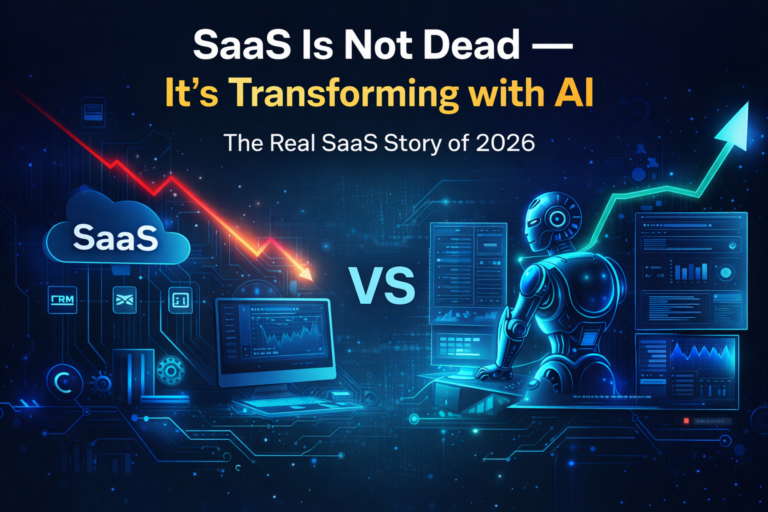
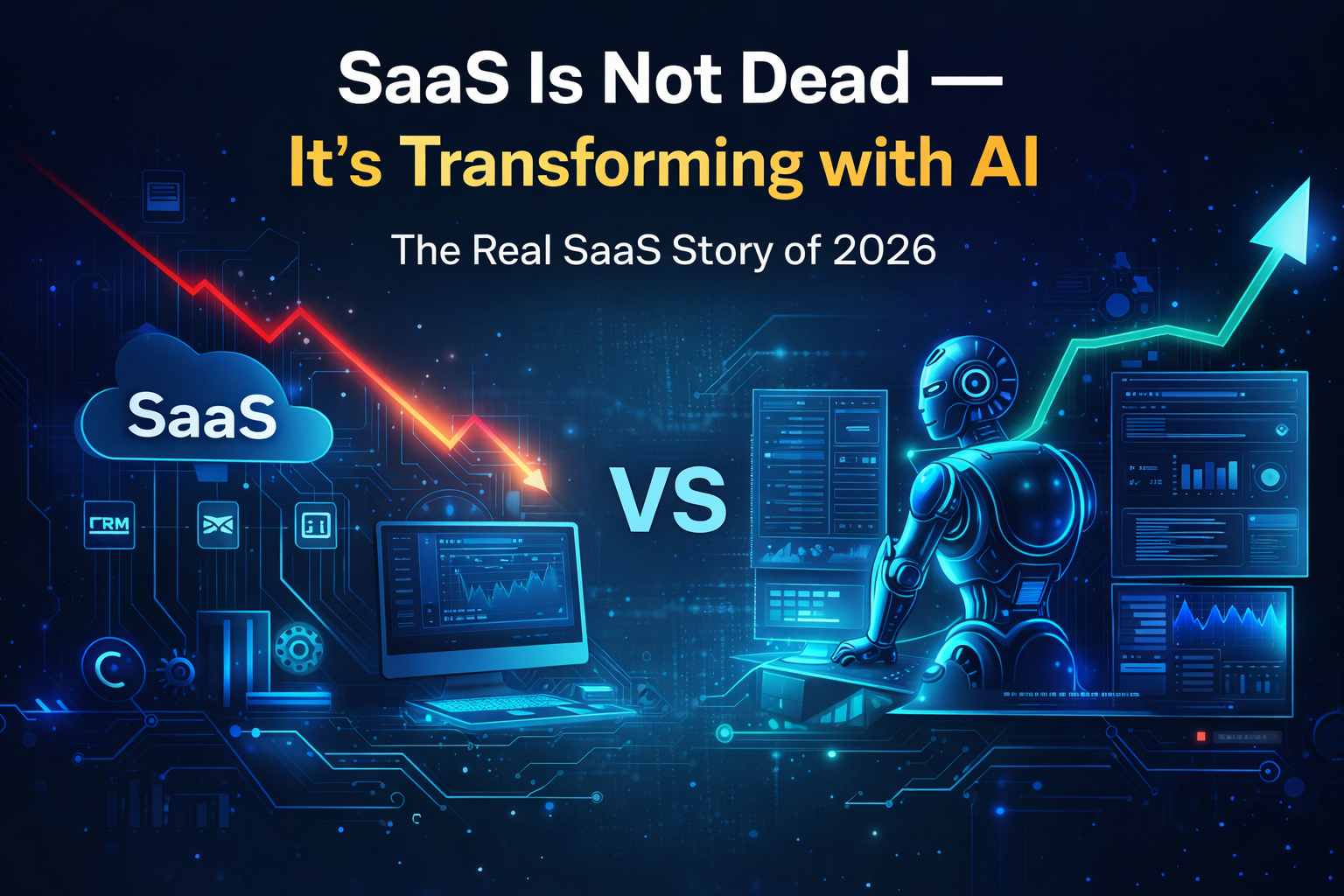
SaaS isn’t dying.
It’s going through the most significant transformation it has seen in 20 years.
And if you work in tech, buy software, build products, or invest in companies — understanding what’s actually shifting right now is genuinely important.
Let’s get into it.
First: What’s the “SaaS-Pocalypse” Everyone Is Talking About?
Starting in late January 2026, investors began dumping SaaS stocks at a pace that alarmed the market.
The iShares Expanded Tech-Software Sector ETF — which tracks major software names like Microsoft, Palantir, and Oracle — was down 30% through April 10, 2026, while the broader S&P 500 was basically flat.
Cloudflare dropped 12% in a single session. ServiceNow fell sharply. CrowdStrike tumbled. The sell-off spread across the sector like a contagion.
The theory driving it: AI agents and new coding tools from companies like Anthropic and OpenAI are about to make traditional pay-per-seat software obsolete. If your IT team can “vibe code” internal software over a weekend, or if an AI agent can handle the workflows that used to require ten software subscriptions — why are you still paying $280 million a year in SaaS fees?
That’s a real question. But the answer is more complicated than the panic suggests.
SaaStr put it plainly: nobody is building a homegrown CRM in a weekend to replace their Salesforce instance. Shipping a basic v1 is maybe 2% of the work. Even if you could build a rough version of Salesforce over a weekend — and you can’t, not really — who maintains it afterward? Who adds the 10,000 features enterprises actually need? Who handles security audits, compliance requirements, and integrations with hundreds of other tools?
The fear is real. The immediate threat is overblown.
But something is genuinely changing — and that’s what this article is actually about.
The Real Story: AI Is Rebuilding How SaaS Works From the Inside
Forget the stock market noise for a moment.
Here’s the more important thing happening in SaaS today:
AI is moving from a feature bolted onto existing software into the core logic of how software operates.
There’s a useful way to think about this. Right now, SaaS products are splitting into two categories:
AI-enabled SaaS — traditional platforms that have added AI features on top. Helpful, but fundamentally the same architecture underneath.
Native-AI SaaS — solutions built from scratch with AI agents at the core. These don’t augment human workflows. They replace them with autonomous execution.
The companies that get this distinction right will dominate the next decade. The ones that treat AI as a marketing feature will struggle. And notably, vertical SaaS companies — those built for specific industries like healthcare, legal, or logistics — are already proving more resilient than generalist horizontal tools, because deep domain expertise is genuinely hard for AI to replicate quickly.
And there’s real evidence this matters already.
Automation Anywhere, a company that builds AI agents for enterprise IT, released data in April 2026 showing its AI agents were resolving more than 80% of employee service requests on average — potentially reducing IT service management licensing costs up to 50%.
That’s not a product pitch. That’s a structural challenge to every legacy ITSM vendor charging per-seat for a human-driven service desk.
The Pricing Revolution: The Seat Is Dying
Here’s a change that will affect every SaaS company, every buyer, and every investor over the next three years.
The per-seat pricing model — the foundation of the SaaS industry for 20 years — is under serious pressure.
The logic was simple and elegant: more employees using the software meant more revenue for the vendor. Predictable. Budgetable. Companies like Salesforce, Workday, and ServiceNow were built on it.
AI agents break that logic.
If 10 AI agents can do the work of 100 sales reps, you don’t need 100 Salesforce seats anymore. You need 10. That’s a 90% reduction in seat revenue for the same work output.
According to Gartner, by 2030, at least 40% of enterprise SaaS spend will shift toward usage-, agent-, or outcome-based pricing.
And that transition is already starting.
What are the new models?
- Usage-based: You pay for what you actually consume — API calls, tokens, compute time, workflows executed. Flexible and fair in theory, but unpredictable in practice. In Zylo’s 2026 SaaS Management Index, 78% of IT leaders reported unexpected charges due to consumption-based pricing models.
- Outcome-based: You pay for results. Intercom’s Fin AI Agent charges $0.99 each time it fully resolves a customer issue. Not for access. Not for seats. For a completed job. That’s a fundamental reimagining of what software costs.
- Agent-seat pricing: A middle ground — you pay per AI agent deployed, similar to a per-user seat but for digital workers. Each AI “employee” gets a seat. Familiar model, different occupant.
The transition isn’t clean. Enterprises still largely prefer predictable per-seat pricing because it’s easy to budget. But the direction is clear: the industry is slowly moving from paying for access to paying for outcomes.
The Numbers: How Big Is the Spending Shift?
Let’s ground this in real data.
According to Zylo’s 2026 SaaS Management Index, organizations spent an average of $1.2 million on AI-native apps — a 108% year-over-year increase.
Deloitte’s 2025 Tech Value survey found that 57% of respondents were putting between 21% and 50% of their annual digital transformation budgets into AI automation. By 2026, Deloitte predicts up to half of organizations will direct more than 50% of their digital transformation budgets toward AI automation.
The global SaaS market is projected to reach $1.58 trillion by 2033 at a 19.3% compound annual growth rate.
Large enterprises typically run 300–500+ SaaS applications and spend anywhere from $100 million to $280 million or more annually on software, depending on size and industry.
The hyperscalers alone — Microsoft, Google, AWS, Meta — will spend $470 billion+ on AI infrastructure in 2026.
That last number matters. That’s $470 billion going into the AI infrastructure layer. A significant portion of it is coming out of enterprise software budgets. CIOs are making hard choices about what stays and what gets consolidated.
App Fatigue Is Real: CIOs Are Cutting, Not Adding
Here’s something that doesn’t get enough coverage in SaaS news:
The era of “best-of-breed” SaaS is over.
For years, the playbook was simple: buy the best tool for every job. Best CRM. Best HR platform. Best marketing automation. Best project management. Best customer support. Stack them together and you’d have a best-in-class tech stack.
That produced hundreds of applications per enterprise — often 300 to 500+ — and a management nightmare.
In 2026, CIOs are consolidating. The conversation has shifted to fewer vendors, not more. Platforms over point solutions. Reduce complexity, not add it.
This was already happening before AI. AI just made it urgent.
Because now there’s a real question: if an AI agent can do the work of several specialized tools, why maintain subscriptions to all of them? Why pay for a dedicated survey tool, a separate analytics tool, and a separate reporting tool — when one platform with a capable AI layer can handle all three?
The market is responding. SaaS consolidation is accelerating. Smaller, undifferentiated horizontal tools — those that solve a narrow problem without deep integration or strong AI capabilities — are the most vulnerable. Gartner’s analysis shows that SaaS vendors are already driving renewal uplifts of 10–20% on average, far exceeding inflation. That’s not sustainable when buyers are actively looking for reasons to cut.
The Security Problem Nobody Talks About Enough
There’s a darker side to SaaS news in 2026 that deserves real attention.
As businesses have accumulated hundreds of SaaS applications, their security posture has quietly become a nightmare.
Your firewall is well-monitored. Your endpoint detection is tuned. But your Salesforce instance? Your Workday tenant? Your Slack workspace? Most organizations are flying blind.
The attack pattern is elegant in its simplicity. Attackers steal valid credentials, OAuth tokens, or session cookies — then just log in. No brute force. No network breach. Your SaaS apps trust those credentials implicitly. The attacker is inside.
The trend toward credential theft and OAuth token hijacking is accelerating specifically because it bypasses the defenses companies have spent years building around their network perimeter. Once inside via a trusted token, attackers can move laterally across your highest-value data stores — CRM customer records, HR payroll data, unfiltered Slack communications — often without triggering a single alert. Most monitoring tools simply weren’t designed to understand SaaS-specific attack patterns.
Security researchers are calling 2026 the year SaaS breaches go from trend to epidemic. The credentials are cheap. The targets are rich. The defenses are weak.
For companies running large SaaS estates, this is not a distant risk. It’s an operational reality that requires immediate investment in SaaS-specific security monitoring, comprehensive logging across every platform, and a fundamental shift in how identity and access are managed across cloud applications.
What Goldman Sachs Said That Moved Markets
One piece of real-time news worth noting.
In the middle of the SaaS sell-off — on Friday, April 10, 2026 — Goldman Sachs published a note identifying a “value opportunity” in the tech sector.
The following Monday, SaaS stocks rallied broadly. The IGV software ETF was up more than 4%, even as the broader market was flat.
Goldman’s read: the sector is oversold. The fundamental businesses of many of these companies remain strong. The AI disruption narrative has caused a market overreaction that has priced in fears much faster than the actual threat can materialize.
They’re probably right — in the near term. Enterprise software is deeply embedded. Contracts are long. Migrations are expensive. Nobody is ripping out their Workday instance because an AI agent could theoretically do some of its work.
But the reprieve doesn’t change the underlying trajectory. The business model pressure is real. It’s just a matter of timing, not direction.
The Winners: Who Is Actually Thriving Right Now
Not everyone in SaaS is struggling. Far from it.
Vertical SaaS is outperforming horizontal SaaS by a significant margin. Companies that build deep, specialized software for specific industries — healthcare, legal, construction, logistics — are growing faster than generalist horizontal tools, because AI hasn’t (yet) made deep domain expertise easy to replicate.
Infrastructure and security tools are resilient. Companies at the infrastructure layer — connectivity, identity management, data platforms — remain essential regardless of how the AI agent conversation evolves.
Native-AI SaaS companies are the real growth story. Startups built from the ground up around AI agents — not as features but as core architecture — are attracting the most investor interest and the fastest enterprise adoption. The companies to watch in 2026 are the ones that answer the question: “Who are the new SaaS companies that don’t look like the old ones?”
AI spending itself is the biggest tailwind. According to Zylo, AI-native app spending doubled year-over-year. That’s money moving within the software budget — away from legacy point solutions and toward AI-native platforms.
Five Signals That Actually Matter in SaaS Right Now
Cut through the noise with these five indicators of what’s genuinely happening:
1. Watch how companies are changing their pricing. A SaaS company moving from per-seat to outcome-based pricing isn’t doing it for fun. It’s doing it because buyers are demanding proof of value. That’s a signal the company is serious about AI, not just marketing it.
2. Watch renewal rates more than ARR headlines. Annual Recurring Revenue growth is easy to inflate with price increases and multi-year contracts. Net Revenue Retention — whether existing customers are actually expanding their usage — is the number that tells you whether a SaaS product is truly delivering value in the AI era.
3. Watch which verticals are consolidating. In categories where a single AI-native platform can serve multiple needs, look for the winner-takes-most dynamic. That’s happening in customer support, HR, sales enablement, and marketing automation already.
4. Watch enterprise IT spending decisions. When a CIO at a Fortune 500 company announces they’re cutting their SaaS vendor count from 600 to 300, that’s not just a budget decision. It’s a strategic signal about which categories AI has made redundant and which ones still require dedicated software.
5. Watch the AI agent “renewal cliff.” Most enterprise AI software subscriptions from 2025 are now hitting their first renewal cycle. Companies that bought AI tools in “AI adoption at all costs” mode — without measuring actual ROI — are now being asked to justify the spend. The ones that can’t demonstrate real value will get cut. That’s a signal worth tracking.
The Honest Assessment: Is SaaS Dead?
No.
But the easy version of SaaS — build a product, charge per seat, grow by adding users, enjoy 80–90% gross margins forever — that version is under real pressure.
The future of SaaS is software that does things, not just enables things.
The companies that survive and thrive will be the ones that answer: “What work am I actually doing for my customer, and am I pricing for that work rather than for access to it?”
That’s a harder product to build. It requires a different business model. It demands different metrics and different conversations with customers.
But it’s also an enormous opportunity.
The SaaS market is still growing toward $1.58 trillion by 2033. The businesses that aren’t building AI-native products today are going to lose ground to ones that are. The transition from “AI-enabled” to “AI-native” is happening faster than most incumbents are moving.
The SaaS-pocalypse isn’t happening.
But the SaaS transformation absolutely is.
And the companies that treat today’s turbulence as a buying opportunity — not just in stocks, but in product strategy and customer relationships — are the ones that will define what software looks like in 2030.
Key Stats at a Glance
| Metric | Number | What It Means |
|---|---|---|
| IGV SaaS ETF decline (YTD to Apr 10) | −30% | Market pricing in AI disruption fears |
| AI-native app spend growth (2025–2026) | +108% YoY | Budget shifting fast toward AI-native tools |
| Enterprise SaaS apps (typical large org) | 300–500+ | App fatigue driving consolidation urgency |
| Large enterprise SaaS spend (annual range) | $100M–$280M+ | Enormous target for AI-driven optimization |
| SaaS market forecast by 2033 | $1.58 trillion | Long-term growth remains intact |
| IT leaders hit by unexpected AI charges | 78% | Consumption pricing creating budget chaos |
| Gartner: SaaS renewal uplifts (avg) | 10–20% | Far above inflation — buyer resistance growing |
| Hyperscaler AI infrastructure spend 2026 | $470B+ | Competing directly for enterprise software budgets |
What to Watch for the Rest of 2026
The renewal cliff: Enterprise AI subscriptions from 2025 pilot programs are now hitting first renewals. Products that can’t show real ROI will get cut in Q2 and Q3 2026.
M&A acceleration: Larger platforms will continue acquiring smaller, point-solution SaaS companies — either to absorb their functionality or to eliminate a competitor. Expect significant deal volume in the second half of 2026.
Pricing model experiments: The next 12 months will produce the most interesting SaaS pricing innovation in years. Watch which companies successfully navigate the transition to outcome-based pricing and which ones get stuck in the “complicated consumption model” trap.
Vertical SaaS rising: The most defensible SaaS businesses right now are the ones with deep industry expertise. Watch for more vertical-specific platforms attracting both capital and enterprise contracts away from horizontal generalists.
AI security becoming mandatory: As SaaS breaches escalate, expect regulatory pressure to increase significantly. Compliance requirements around SaaS security monitoring, identity management, and data governance will become a significant cost center — and a competitive differentiator for vendors who get ahead of it.
The Bottom Line
Here’s the simplest way to understand SaaS news today:
The industry spent 20 years selling access to software.
The next 20 years will be built on selling outcomes from software.
That’s a fundamental change. Not a death. Not a collapse. A transformation.
The companies — and the buyers — who understand that difference earliest will have a significant advantage over those who figure it out when it’s obvious to everyone.
The turbulence is real.
The opportunity is bigger.
Further Reading
- SaaStr — saastr.com — Honest, operator-level SaaS analysis
- Deloitte: AI Agents and SaaS — deloitte.com — Comprehensive look at how agentic AI is reshaping enterprise software
- Zylo 2026 SaaS Management Index — zylo.com — Real spending data on AI-native SaaS adoption
- Bessemer Venture Partners: AI Pricing Playbook — bvp.com — The venture perspective on how AI companies should price
- BetterCloud SaaS Industry Guide — bettercloud.com — IT and operations perspective on managing SaaS in the AI era
About The Author