
Amazon A10 Algorithm Explained: The Complete Guide to Ranking Higher on Amazon
In This Article
- Stage 1: Relevance
- Stage 2: Performance
- Top Amazon A10 Ranking Factors That Influence Product Rankings
- 1. Keyword Relevance
- Best Practice
- 2. Sales Velocity
- Ways to Increase Sales Velocity
- 3. Click-Through Rate (CTR)
- How to Improve CTR
- 4. Conversion Rate
- Improve Conversion Rate By
- 5. Customer Reviews
- Best Practices
- 6. Product Images
- 7. Pricing Strategy
- 8. Inventory Availability
- 9. External Traffic
- 10. Amazon PPC & Organic Rankings
- Why a Complete Amazon SEO Strategy Matters
- 10 Proven Amazon SEO Strategies to Rank Higher in 2026
- 1. Perform Proper Keyword Research
- Recommended Tools
- 2. Optimize Your Product Title
- 3. Write Benefit-Focused Bullet Points
- 4. Invest in High-Quality Images
- 5. Create Premium A+ Content
- 6. Optimize Backend Search Terms
- 7. Use Amazon PPC Strategically
- 8. Monitor Customer Feedback
- 9. Drive Qualified External Traffic
- 10. Continuously Optimize Your Listing
- Common Amazon SEO Mistakes
- Keyword Stuffing
- Poor Images
- Ignoring Backend Keywords
- Running Out of Stock
- Weak Product Descriptions
- Ignoring Customer Questions
- Not Updating Listings
- Best Amazon SEO Tools
- Helium 10
- Jungle Scout
- DataDive
- Keepa
- What is the Amazon A10 Algorithm?
- Is the Amazon A10 Algorithm officially confirmed by Amazon?
- Does Amazon PPC improve organic rankings?
- Which ranking factor is the most important?
- How important are customer reviews?
- Conclusion
- Expert Insight
- References
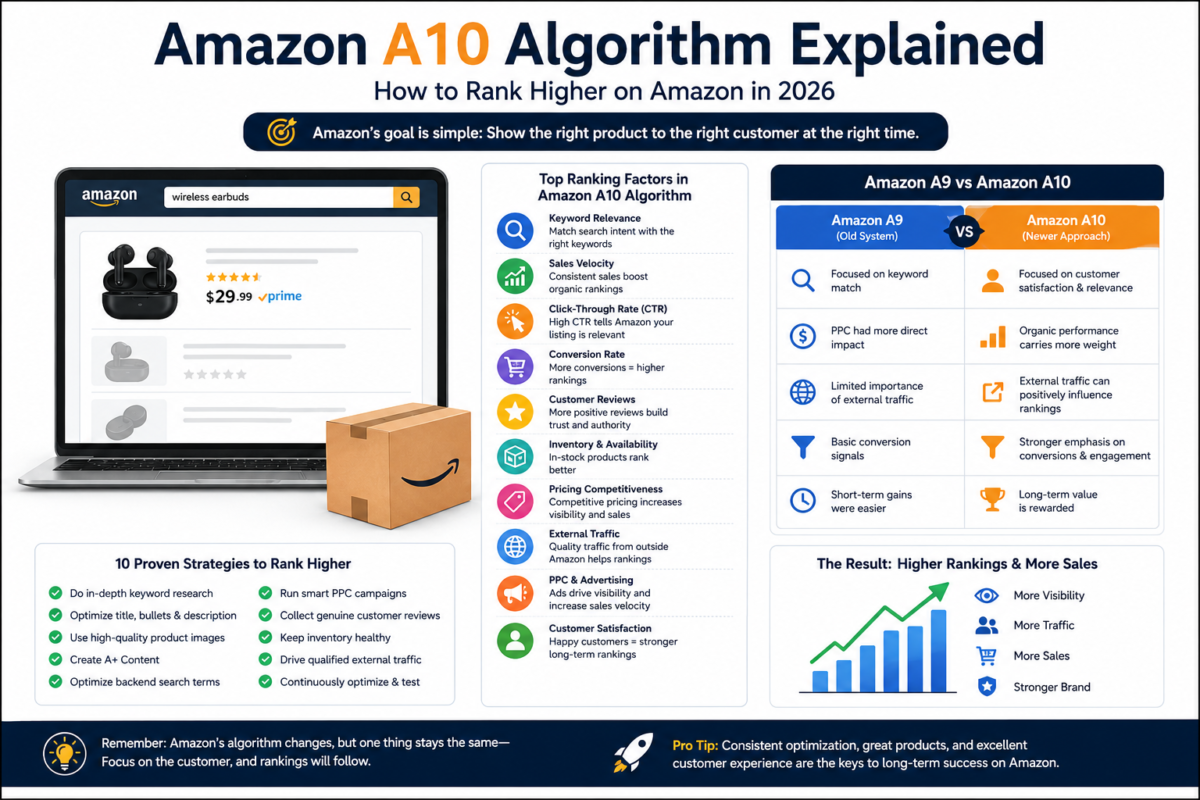
If you sell products on Amazon, you’ve probably heard the term Amazon A10 Algorithm. Many sellers believe it replaced the older A9 algorithm and changed how products rank in Amazon search results. While Amazon has never officially confirmed the name “A10,” the term is widely used across the eCommerce industry to describe the platform’s evolving search and ranking system.
Today, ranking on Amazon isn’t just about stuffing keywords into your product title. Success depends on delivering a great customer experience, maintaining strong sales performance, optimizing your listings, and building trust with shoppers.
In this guide, we’ll explain what the Amazon A10 Algorithm is, how it differs from previous ranking models, and the practical strategies that can help improve your product visibility in 2026.
What Is the Amazon A10 Algorithm?
The Amazon A10 Algorithm refers to the collection of ranking signals that Amazon uses to determine which products appear first in search results. Although the name “A10” isn’t officially recognized by Amazon, it represents the idea that Amazon has shifted toward rewarding listings that provide better value to customers rather than relying heavily on advertising alone.
Amazon’s primary goal has always been simple: show shoppers the products they are most likely to buy.
To achieve that, the algorithm analyzes hundreds of signals, including:
- Keyword relevance
- Product sales history
- Conversion rate
- Customer reviews
- Inventory availability
- Pricing competitiveness
- Seller performance
- Product images
- Click-through rate
- Customer satisfaction
Instead of focusing on one factor, Amazon evaluates how well all these signals work together to create a positive shopping experience.
Is Amazon A10 Official?
This is an important question.
Many blogs and YouTube videos present the A10 Algorithm as an official update from Amazon. However, Amazon has never publicly confirmed that its search engine is called “A10.”
The term became popular within the Amazon seller community to describe changes in ranking behavior observed over time.
Therefore, when discussing the Amazon A10 Algorithm, it’s more accurate to think of it as an industry nickname rather than an official Amazon announcement.
This distinction is important because high-quality SEO content should always separate confirmed facts from industry observations.
Amazon A9 vs. Amazon A10
Although both systems aim to connect shoppers with the most relevant products, many sellers believe newer ranking signals place greater emphasis on customer satisfaction and long-term performance.
| Amazon A9 | Amazon A10 (Industry Term) |
|---|---|
| Strong focus on keyword relevance | Greater emphasis on customer experience |
| PPC had a larger influence | Organic sales quality appears more important |
| Limited external traffic value | External traffic may contribute positively |
| Basic conversion signals | Stronger behavioral signals |
| Simple optimization strategies | Holistic listing optimization |
Rather than relying solely on advertising, sellers now need to optimize every part of their Amazon business.
How the Amazon Ranking System Works
Every time a customer types a keyword into Amazon’s search bar, the platform evaluates millions of products within seconds.
The ranking process generally follows two major stages:
Stage 1: Relevance
Amazon first identifies listings that are relevant to the customer’s search.
It evaluates:
- Product title
- Bullet points
- Backend keywords
- Product description
- Brand name
- Category
- Search terms
If your listing isn’t relevant, it won’t appear regardless of how many sales you generate.
The Amazon A10 Algorithm rewards listings that provide a better customer experience.
Stage 2: Performance
After identifying relevant products, Amazon compares their performance using behavioral and commercial signals.
These include:
- Historical sales
- Conversion rate
- Click-through rate (CTR)
- Review quality
- Return rate
- Inventory status
- Pricing
- Customer satisfaction
Products that consistently satisfy customers are generally more likely to rank higher over time.
Why Amazon SEO Matters More Than Ever
Amazon has become one of the world’s largest product search engines. Millions of shoppers start their buying journey directly on Amazon instead of using traditional search engines.
That means ranking organically can significantly reduce advertising costs while increasing long-term profitability.
A well-optimized listing can:
- Generate consistent organic traffic
- Improve conversion rates
- Lower Advertising Cost of Sales (ACoS)
- Increase customer trust
- Strengthen brand authority
- Improve overall sales performance
For brands that want sustainable growth, investing in Amazon SEO is no longer optional—it’s a necessity.
Top Amazon A10 Ranking Factors That Influence Product Rankings
Understanding how Amazon ranks products is the key to building a successful eCommerce business. While no one outside Amazon knows the exact algorithm, years of testing by experienced sellers and agencies have shown several factors that consistently influence rankings.
Let’s examine the most important ranking signals.
Many Amazon sellers now use advanced AI models for keyword research, listing optimization, and product content. You can also explore our comparison of ChatGPT vs Gemini vs DeepSeek to understand which AI assistant is better for eCommerce workflows.
1. Keyword Relevance
Keyword relevance is the foundation of Amazon SEO. If Amazon cannot understand what your product is, it cannot show it to shoppers.
Your primary keyword should naturally appear in:
- Product Title
- Bullet Points
- Product Description
- Backend Search Terms
- Image Alt Text (where applicable)
- A+ Content
However, avoid keyword stuffing. Amazon prefers listings that read naturally while clearly describing the product.
Best Practice
Instead of writing:
Water Bottle Stainless Steel Bottle Gym Bottle BPA Free Bottle Sports Bottle
Write:
Stainless Steel Water Bottle – 32 oz Vacuum Insulated Sports Bottle for Gym, Travel & Outdoor Activities
The second example is easier to read and still contains relevant keywords.
2. Sales Velocity
Sales velocity refers to how quickly your product sells over a given period.
Amazon rewards products that consistently generate sales because they indicate strong customer demand.
Products with steady daily sales usually outperform products that experience occasional spikes followed by inactivity.
Ways to Increase Sales Velocity
- Launch effective PPC campaigns.
- Optimize your listing before advertising.
- Offer limited-time discounts.
- Use Amazon Coupons.
- Participate in seasonal events like Prime Day or Black Friday.
Remember, Amazon values consistent growth, not just short-term bursts.
3. Click-Through Rate (CTR)
Click-Through Rate (CTR) measures how many shoppers click on your listing after seeing it in search results.
A high CTR tells Amazon that customers find your product attractive.
Several elements influence CTR:
- Main image quality
- Product title
- Brand recognition
- Price
- Ratings
- Prime eligibility
How to Improve CTR
- Use high-quality images with a pure white background.
- Keep titles clear and informative.
- Display competitive pricing.
- Earn positive customer reviews.
- Use attractive packaging where visible.
Even if your product ranks well, a poor CTR can reduce your visibility over time.
4. Conversion Rate
After shoppers click on your listing, Amazon measures how many actually purchase the product.
This is known as the Conversion Rate (CVR).
A high conversion rate is one of the strongest signals that your listing satisfies customer expectations.
Improve Conversion Rate By
- Writing persuasive bullet points.
- Adding professional lifestyle images.
- Including comparison charts.
- Creating Premium A+ Content.
- Answering customer questions.
- Addressing objections before purchase.
Amazon wants shoppers to find exactly what they need without leaving the platform.
5. Customer Reviews
Customer reviews remain one of the most influential ranking factors.
Products with higher ratings and a larger number of genuine reviews often perform better than similar products.
However, quality matters more than quantity.
A product with 500 reviews averaging 4.8 stars may outperform another with 2,000 reviews averaging 3.9 stars.
Best Practices
- Never purchase fake reviews.
- Use Amazon Vine if eligible.
- Deliver excellent customer service.
- Improve product quality based on customer feedback.
Authentic reviews build trust and improve long-term rankings.
6. Product Images
Images play a major role in both CTR and Conversion Rate.
Most customers decide whether to click based on the main image alone.
Your listing should include:
- Main product image
- Lifestyle images
- Close-up details
- Infographics
- Dimensions
- Packaging
- Comparison charts
- Product in use
Professional visuals help customers understand the product before purchasing.
7. Pricing Strategy
Amazon continuously compares prices across its marketplace.
If your pricing is significantly higher than competitors without offering additional value, rankings may suffer.
This doesn’t always mean being the cheapest.
Instead, aim for competitive pricing while highlighting unique benefits.
You can also use:
- Coupons
- Limited-time deals
- Subscribe & Save
- Business discounts
These features can improve both visibility and conversions.
8. Inventory Availability
Running out of stock can significantly impact organic rankings.
When inventory reaches zero:
- Sales stop.
- Ranking signals weaken.
- Competitors gain visibility.
- Recovery can take weeks.
Inventory planning is therefore a critical part of Amazon SEO.
Use forecasting tools and monitor inventory regularly to avoid stock-outs.
9. External Traffic
Amazon increasingly values qualified traffic coming from outside its platform.
Sources may include:
- Google Search
- YouTube
- Email marketing
- Blogs
External visitors who convert into buyers send positive engagement signals.
Instead of sending random traffic, focus on attracting shoppers who are genuinely interested in your products.
10. Amazon PPC & Organic Rankings
Many sellers believe PPC alone improves rankings.
The reality is more nuanced.
Advertising increases visibility, which can generate additional clicks and sales.
If those visitors convert well, the increased sales performance may contribute to stronger organic rankings over time.
A successful strategy combines:
- Optimized listings
- Targeted PPC campaigns
- Competitive pricing
- High-quality images
- Positive customer reviews
PPC should support your SEO not replace it.
Why a Complete Amazon SEO Strategy Matters
Amazon’s ranking system evaluates dozens of signals simultaneously.
No single factor guarantees first-page rankings.
Success comes from improving every aspect of your listing and customer experience.
Brands that consistently invest in listing optimization, advertising, inventory management, and customer satisfaction are more likely to achieve sustainable organic growth.
10 Proven Amazon SEO Strategies to Rank Higher in 2026
Now that you understand the major ranking factors behind the Amazon A10 Algorithm, it’s time to implement practical strategies that can improve your product’s visibility and increase sales.
The most successful Amazon sellers don’t rely on a single tactic. Instead, they optimize every aspect of their listing while continuously monitoring performance and making improvements.
Let’s explore the strategies that consistently deliver long-term results.
1. Perform Proper Keyword Research
Keyword research is the foundation of every successful Amazon listing.
If you’re targeting the wrong keywords, even the best product may struggle to generate sales.
Instead of focusing only on high-volume keywords, identify keywords with strong buyer intent.
For example:
Instead of targeting:
Water Bottle
Target:
Stainless Steel Insulated Water Bottle
or
BPA Free Gym Water Bottle
Long-tail keywords usually have lower competition and attract shoppers who are ready to purchase.
Recommended Tools
- Helium 10
- Jungle Scout
- DataDive
- Amazon Search Suggestions
- Brand Analytics
2. Optimize Your Product Title
Your title is one of the first things both shoppers and Amazon’s algorithm analyze.
A strong title should include:
- Primary Keyword
- Brand Name
- Product Type
- Important Features
- Size
- Quantity
- Color (if relevant)
Example:
BrandX Stainless Steel Water Bottle – 32oz Vacuum Insulated Sports Bottle with Leakproof Lid
Avoid:
- ALL CAPS
- Keyword stuffing
- Unnecessary symbols
- Repeating the same keyword
A clean, readable title improves both rankings and click-through rate.
3. Write Benefit-Focused Bullet Points
Many sellers only describe product features.
Successful listings explain how those features solve customer problems.
Instead of:
✔ Double Wall Insulation
Write:
✔ Keeps drinks cold for up to 24 hours and hot for 12 hours, making it perfect for travel, work, and outdoor activities.
Focus on benefits rather than specifications.
4. Invest in High-Quality Images
Customers cannot physically inspect products on Amazon.
Images become your salesperson.
Your listing should include:
- Main image
- Lifestyle images
- Feature callouts
- Product dimensions
- Packaging
- Comparison chart
- Product in use
- Infographic
Professional images increase both CTR and conversions.
5. Create Premium A+ Content
If your brand is registered with Amazon Brand Registry, Premium A+ Content can significantly improve the shopping experience.
Include:
- Lifestyle banners
- Feature comparison charts
- Brand story
- FAQs
- Product benefits
- Usage instructions
While A+ Content doesn’t directly improve keyword indexing, it often increases conversion rates—which indirectly supports better rankings.
6. Optimize Backend Search Terms
Amazon provides backend search fields where you can add additional keywords that don’t naturally fit into your visible listing.
Best practices include:
- Avoid repeating keywords already in your title.
- Don’t include punctuation.
- Avoid competitor brand names.
- Use synonyms and alternative search phrases.
Backend keywords help Amazon better understand your product without affecting the customer experience.
7. Use Amazon PPC Strategically
Advertising should complement your SEO efforts—not replace them.
Start with:
- Automatic Campaigns
- Manual Broad Match
- Phrase Match
- Exact Match
Analyze search term reports regularly.
Pause low-performing keywords and increase bids on profitable search terms.
As your organic rankings improve, gradually reduce dependency on paid traffic for high-performing keywords.
8. Monitor Customer Feedback
Customer reviews provide valuable insights into what buyers like—and what needs improvement.
Pay close attention to recurring complaints.
Examples:
- Packaging issues
- Product quality
- Sizing problems
- Missing accessories
- Confusing instructions
Improving your product based on customer feedback not only increases satisfaction but also reduces return rates and strengthens long-term ranking signals.
9. Drive Qualified External Traffic
Amazon rewards listings that attract high-quality external visitors who convert into buyers.
Some effective traffic sources include:
- Google Search
- YouTube
- Email Marketing
- Industry Blogs
Instead of sending random visitors, focus on audiences actively searching for products similar to yours.
Quality matters more than quantity.
10. Continuously Optimize Your Listing
Amazon SEO is not a one-time task.
Successful brands regularly test and improve:
- Product titles
- Images
- Bullet points
- Pricing
- Coupons
- PPC campaigns
- Inventory forecasting
- Customer questions
Continuous optimization allows sellers to adapt to changing customer behavior and maintain competitive rankings.
Common Amazon SEO Mistakes
Many sellers unknowingly limit their rankings by making avoidable mistakes.
Some of the most common include:
Keyword Stuffing
Repeating keywords unnaturally makes listings difficult to read and may reduce conversions.
Poor Images
Low-quality product images often result in poor click-through rates.
Ignoring Backend Keywords
Many listings leave valuable indexing opportunities unused.
Running Out of Stock
Inventory interruptions can significantly reduce organic visibility.
Weak Product Descriptions
Customers need clear information before making a purchase.
A detailed description answers questions and builds confidence.
Ignoring Customer Questions
The Questions & Answers section is often overlooked despite being an excellent source of customer insights.
Not Updating Listings
Customer expectations and market trends evolve.
Listings should be updated regularly rather than remaining unchanged for years.
Best Amazon SEO Tools
Professional Amazon sellers rely on specialized software to make data-driven decisions.
Helium 10
Ideal for:
- Keyword Research
- Listing Optimization
- Competitor Analysis
- Index Tracking
Jungle Scout
Useful for:
- Product Research
- Opportunity Finder
- Sales Estimates
- Market Analysis
DataDive
Popular among experienced Amazon SEO professionals for advanced keyword clustering and listing optimization.
Keepa
Provides historical data including:
- Price History
- Sales Rank
- Inventory Trends
- Buy Box Changes
Understanding historical trends helps sellers make informed pricing and inventory decisions.
Need Professional Amazon SEO Assistance?
Optimizing an Amazon listing involves much more than adding keywords.
Successful brands continuously improve:
- Product Listings
- Amazon SEO
- PPC Campaigns
- A+ Content
- Product Images
- Conversion Rate Optimization
- Inventory Planning
- Performance Analysis
Businesses looking for professional Amazon growth strategies can work with Exon Solutionz, which provides Amazon account management, listing optimization, PPC management, brand development, and marketplace growth solutions tailored to businesses of all sizes.
Frequently Asked Questions (FAQs)
What is the Amazon A10 Algorithm?
The Amazon A10 Algorithm is an industry term used to describe the modern ranking system believed to power Amazon’s search results. While Amazon has never officially confirmed the name “A10,” sellers use it to refer to ranking factors that emphasize customer experience, relevance, conversions, and overall listing quality.
Is the Amazon A10 Algorithm officially confirmed by Amazon?
No. Amazon has never publicly confirmed that its search algorithm is called “A10.” The name comes from observations made by Amazon sellers, consultants, and industry experts based on changes in ranking behavior over time.
Does Amazon PPC improve organic rankings?
PPC does not directly increase organic rankings. However, well-optimized advertising campaigns can generate additional clicks and sales. If those visitors convert into customers, the improved sales performance may contribute to stronger organic visibility over time.
Which ranking factor is the most important?
There is no single ranking factor.
Amazon evaluates multiple signals together, including:
Keyword relevance
Sales velocity
Click-through rate
Conversion rate
Reviews
Inventory
Pricing
Customer satisfaction
The best-performing listings are optimized across all of these areas.
How important are customer reviews?
Customer reviews are one of the strongest trust signals on Amazon. High-quality products with positive reviews generally achieve better conversion rates, which can positively influence organic performance.
Conclusion
Amazon’s search algorithm continues to evolve, making it more important than ever for sellers to focus on customer experience rather than relying solely on keywords or paid advertising.
Although the term Amazon A10 Algorithm is not officially recognized by Amazon, the principles associated with it highlight the importance of relevance, conversion optimization, inventory management, customer satisfaction, and long-term business performance.
Instead of searching for shortcuts, successful Amazon brands invest in continuous optimization. They improve product listings, monitor customer feedback, analyze performance data, and adapt to changing market conditions.
Whether you’re launching your first product or managing an established brand, a comprehensive Amazon SEO strategy can significantly improve visibility, increase conversions, and build sustainable long-term growth.
Expert Insight
At TechRush, we believe successful Amazon SEO is a combination of data, testing, and continuous improvement not myths or quick fixes.
Businesses looking to improve their Amazon performance should focus on building listings that genuinely help customers make informed purchasing decisions while maintaining excellent operational standards.
For companies seeking professional support with Amazon SEO, listing optimization, PPC management, and marketplace growth, Exon Solutionz offers comprehensive Amazon account management services designed to help brands grow sustainably.
References
To ensure accuracy, this guide is based on information and best practices from trusted industry resources, including:
- Amazon Seller Central
- Amazon Advertising Learning Console
- Amazon Brand Registry Documentation
- Helium 10 Learning Center
- Jungle Scout Educational Resources
- DataDive Best Practices
- Official Amazon Help Documentation
About The Author


Hamza Malik
Keep Reading
Amazon A10 Algorithm Explained: The Complete Guide to Ranking Higher on Amazon
If you sell products on Amazon, you’ve probably heard the term Amazon A10 Algorithm. Many sellers…